
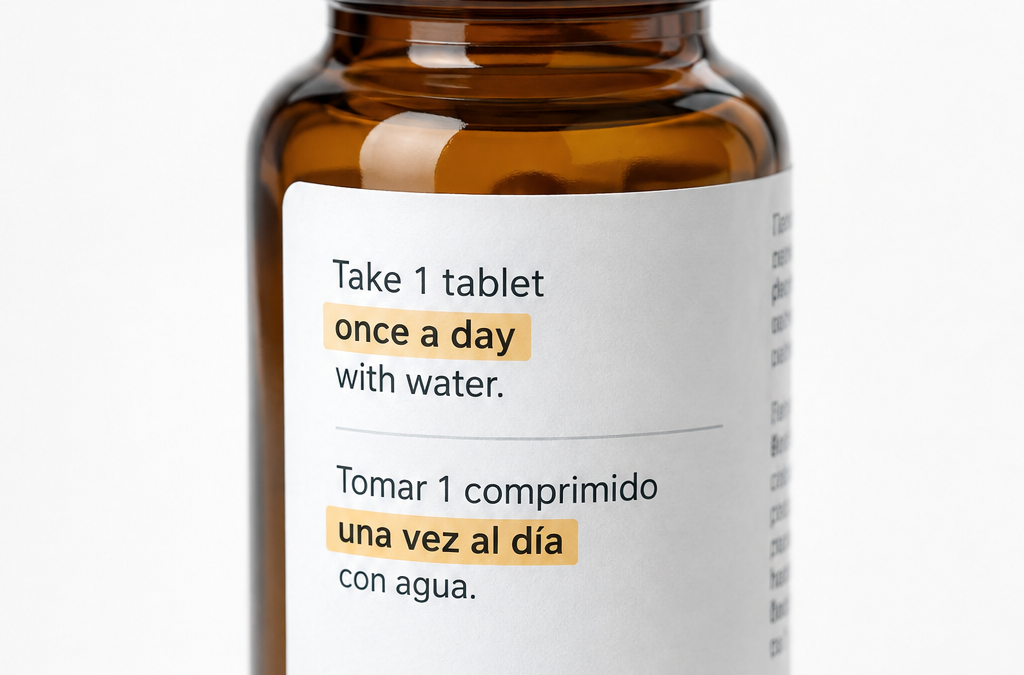
A study of computer-generated Spanish medicine labels found that the instruction ‘once a day’ could appear untranslated. A Spanish-speaking patient could then read a once-daily dose as eleven times a day. That example had nothing to do with cannabis. But the mechanism is the same when a cannabis-derived medicinal product’s Summary of Product Characteristics (SmPC) or patient information leaflet enters a new EU market. Medical cannabis translation Europe carries this structural risk: a single untranslated or incorrectly rendered term in a document subject to pharmaceutical requirements doesn’t just read badly. It can change the dose.
Medical Cannabis Translation Europe: Why ‘Close Enough’ Doesn’t Exist in a Dosage Instruction
In markets like Germany, cannabis-derived products that qualify as medicinal products must meet the applicable pharmaceutical requirements for product information and labelling. Where an SmPC applies, its translation carries the same stakes as any other medicinal product. The Spanish ‘once/eleven’ example shows how a small language error in a medicine label can produce a materially different dosing instruction. No grammar was broken. No sentence was garbled. In fact, the translation held up everywhere except the one word carrying the entire dosing instruction.
Specifically, product information for a cannabis-derived medicinal product entering another EU market may need adaptation to the applicable regulatory procedure. Consistency in controlled terminology matters throughout. As a result, a translator without access to the approved product terminology, relevant standard terms and the target market’s regulatory context can produce fluent text that still misstates strength, frequency or route of administration.
When Labelling Errors Can Lead to Recalls

Labelling and packaging defects already account for a measurable share of pharmaceutical recalls. A 2024 analysis of FDA recall data from 2012 to 2023 found that labelling or packaging issues accounted for roughly 19% of recalls. The average recall involved around 400,000 units. A separate analysis of 195 drug recalls from 2017 to 2019 found that 14.9% were labelling-related. However, these figures cover labelling defects broadly and do not isolate translation errors as a specific cause. They don’t constitute a precise measure of translation risk on their own. Nevertheless, they show how much weight a labelling document carries. A defect discovered after launch can require formal corrective action — including a recall where the defect presents a sufficiently serious risk to patients.
In 2017, the FDA reported a recall of an imported anti-itch lotion. The labelling identified hydrocortisone as the active ingredient. The product actually contained dexamethasone acetate. The manufacturer attributed the discrepancy to a translation mistake. In contrast, the failure mechanism differs from the ‘once/eleven’ case — one involves dosage frequency, the other active-ingredient identification. But both show how a labelling choice that looks minor on the page stops being minor once a patient acts on it.
Medical Cannabis Translation Europe Needs a Locked Termbase, Not Just a Fluent Translator
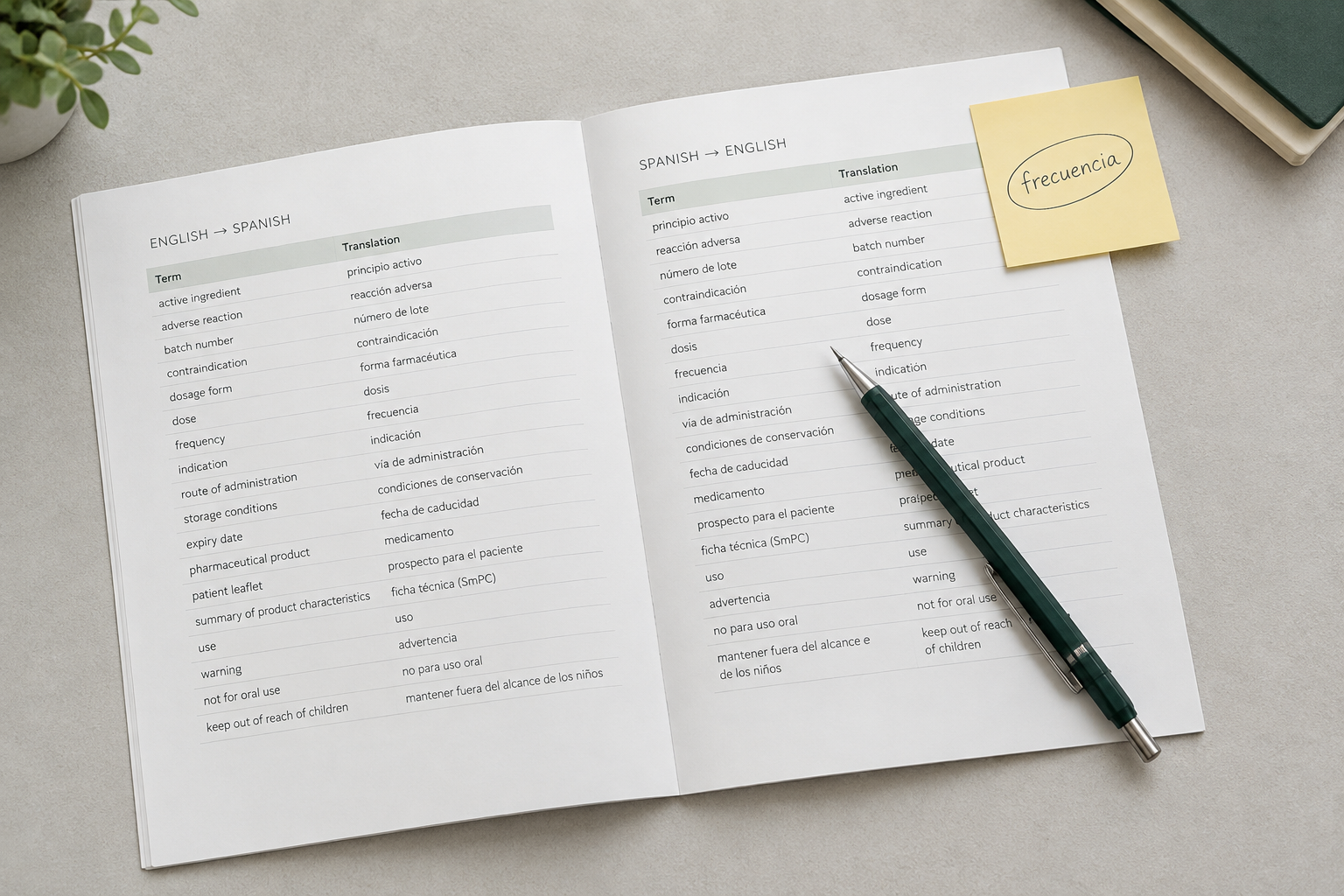
One important control for both failure modes is terminology management. Before translation of the SmPC or patient information leaflet begins, a locked, market-specific glossary sets out how to render dosage units, frequency and active-ingredient names. A review layer then checks the finished document against that glossary — not only against the source text. For cannabis-derived medicinal products subject to pharmaceutical regulation, medical cannabis translation Europe works this way. Therefore, terminology must align with the approved product information, the applicable regulatory vocabulary and the conventions of the target market.
This is where AI-assisted translation earns a caveat rather than a ban. A large language model can produce fluent, grammatically sound draft text quickly. But it cannot reliably establish whether ‘once’ remains an adverb, whether a dosage unit matches the target market’s requirements, or whether a medicinal product name matches the approved product information. That validation step is a specialist function. It is therefore not a byproduct of translation quality. For cannabis-derived medicinal products subject to pharmaceutical regulation, medical cannabis translation Europe is a terminology-management discipline as much as a language one.
Conclusion
A study of computer-generated medicine labels found that a single untranslated word turned a once-daily dose into eleven. Nothing about that failure required bad translation — it required one unlocked term. Cannabis-derived medicinal products crossing into a new EU market under pharmaceutical regulation carry the same exposure. Consequently, the consequences can extend to patient safety, corrective action and potentially a recall. For specialist cannabis translation services across EU markets, visit our cannabis translation specialist services page. The open question for any brand moving a cannabis medicine into a new market: has the terminology been locked, or just the words translated?
This article is for informational purposes only and does not constitute legal advice. Cannabis regulations change rapidly — verify current requirements with qualified legal counsel before making compliance decisions.
Sources:
1. Sharif, S. & Tse, S. — Accuracy of computer-generated Spanish medicine labels — https://pmc.ncbi.nlm.nih.gov/articles/PMC3118429/
2. Ghijs S., Wynendaele E., De Spiegeleer B. — The continuing challenge of drug recalls — Journal of Pharmaceutical and Biomedical Analysis, 2024 — doi:10.1016/j.jpba.2024.116349
3. Livingston et al. — Drug and medical device product failures — https://pubmed.ncbi.nlm.nih.gov/32753251/
4. FDA — Lucky Mart / Piyanping Anti-Itch Lotion recall — FDA.gov
Recent Comments