
The European Union Drug Agency (EUDA) published its European Drug Report 2026 on 9 June, and the cannabis section confirms what most people working in this sector already feel day to day: the market isn’t just present, it’s expanding — in users, in product types, and in potency. For cannabis brands operating across more than one EU market, that growth does not translate automatically into more revenue. It translates into more cannabis labeling work and more product descriptions. More languages need to say the same thing correctly. This is the gap we work in.
What the European Drug Report 2026 means for cannabis labeling
According to the EUDA’s 2026 report, around 25 million Europeans — roughly 8.7% of adults — used cannabis in the past year. The report also points to rising THC potency and a broader diversification of cannabis products on the market, alongside a specific warning: high-potency cannabis from North America is entering the EU. In November 2025, the EUDA issued its first-ever alert through the European Drug Alert System specifically on this trend, citing both potency and pesticide contamination risks.
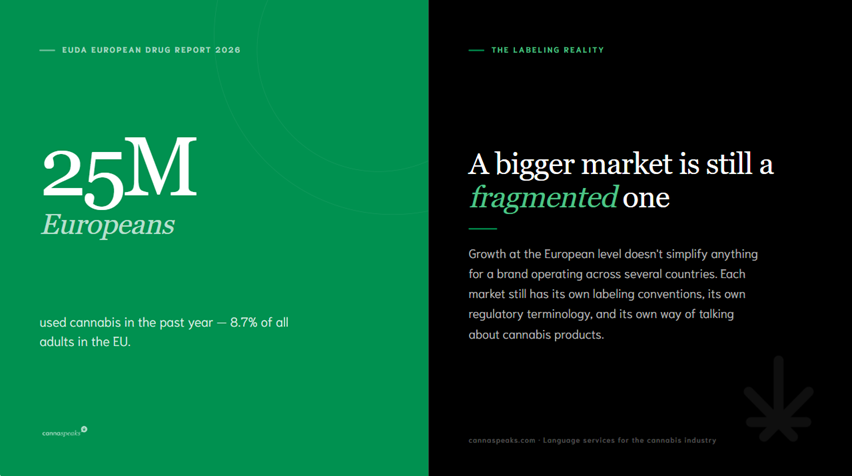
None of these are projections. This is what the market looks like right now, with more product categories than most brands had in mind when they last wrote their product documentation. For a translation and localization agency working across cannabis markets, this report reads less like industry news and more like a checklist. More users means more product lines competing for shelf space. More potency variation means more product tiers that need explaining to the people buying them, in terms that hold up across markets. And more product diversification means more SKUs, each with its own label, leaflet, and set of claims that has to exist in every language a brand operates in.
In cannabis, terminology is rarely just terminology.
A product name, potency descriptor or usage category can influence how a product is understood by distributors, consumers and regulators in different markets.
Product diversification is a translation problem before it’s a marketing one
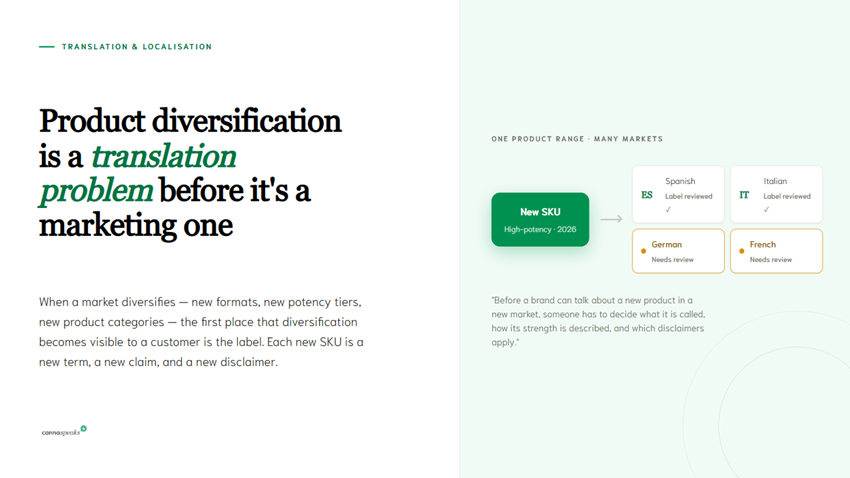
When a market diversifies — new formats, new potency tiers, new product categories — the first place diversification becomes visible is the label and the product page. Before launching in a new market, someone must decide what the product is called. They must determine how its strength is described and which disclaimers apply in that language. Many brands treat this as a copy-paste exercise. They take the home-market product description, run it through a translation tool, and publish. That works reasonably well when the product range is stable and well understood in both markets. It works less well when the product range is changing. New formats are appearing, potency information is becoming more prominent, and higher-strength products from outside the EU are entering the market (per the EUDA report). Each addition is a new term, a new claim, or a new disclaimer. Someone has to check what it actually means in the target market and language.
Cannabis product labeling: a bigger market is still a fragmented one
Growth at the European level is encouraging, but it doesn’t simplify anything for a brand operating in several countries at once. Each market a brand sells into has its own product categories and its own labeling conventions. Rules for talking to consumers and regulators also differ. A larger market does not simplify this. More brands are entering more of these markets at the same time. That increases the number of language versions that need attention, not the simplicity of managing them. The brands that handle this well treat each market’s product documentation as a standalone deliverable. It does not get treated as a translation of a single master version. They review it against that market’s current terminology and labeling conventions. That distinction becomes more important as the market grows and product ranges expand. A report showing 25 million users and a wider product range is good news for demand. It is also a calibration check on translation processes. Demand alone does not reduce the number of places where a label, a claim, or a potency description needs checking.
Conclusion
The European Drug Report 2026 confirms that the EU cannabis market is bigger and more varied. Higher-potency imports are adding competitive pressure too. That growth also means more places where terminology, labeling, and product descriptions can drift from the product’s reality. As the European cannabis market expands, reviewing multilingual product documentation becomes less of a marketing exercise and more of a risk-management one. When did you last review yours? When did you last review yours?
This article is for informational purposes only and does not constitute legal advice. Cannabis regulations change rapidly — verify current requirements with qualified legal counsel before making compliance decisions.
Cannabis brands navigating EU labelling requirements need more than a literal translation. See how Cannaspeaks approaches cannabis translation specialist services for packaging and compliance content.
Fuentes: 1. European Drug Report 2026 (EUDA) 2. European Drug Alert System — North American cannabis alert (Nov. 2025)
Recent Comments