
Your marketing team uses ChatGPT to produce the German version of your CBD product page. The output reads well. The product goes live. Three months later, a compliance review flags a claim under the food and health-claims rules applicable in Germany. The issue is not that the AI cannabis translation was wrong. Nobody checked whether that claim was appropriate for that market.
That is the scenario this post is about. It is also the core limitation of AI cannabis translation: the ability to reproduce language without operating within a compliance framework.
AI cannabis translation is not the same as regulatory-aware localisation
Those are two different tasks, but they are often treated as if they were one.
This is not an argument against AI cannabis translation tools. For general marketing content — brand storytelling, social copy, general corporate messaging — tools like DeepL or ChatGPT can produce fluent, grammatically sound drafts that require relatively little linguistic intervention. The assumption that they work is, for that kind of content, a reasonable one.
The problem appears when cannabis-specific content meets market-specific regulation. That is where the text can be linguistically correct and regulatorily problematic at the same time.
Three places where AI cannabis translation creates a compliance liability
1. Where AI cannabis translation fails: a health claim that reads correctly in one market and creates a problem in another
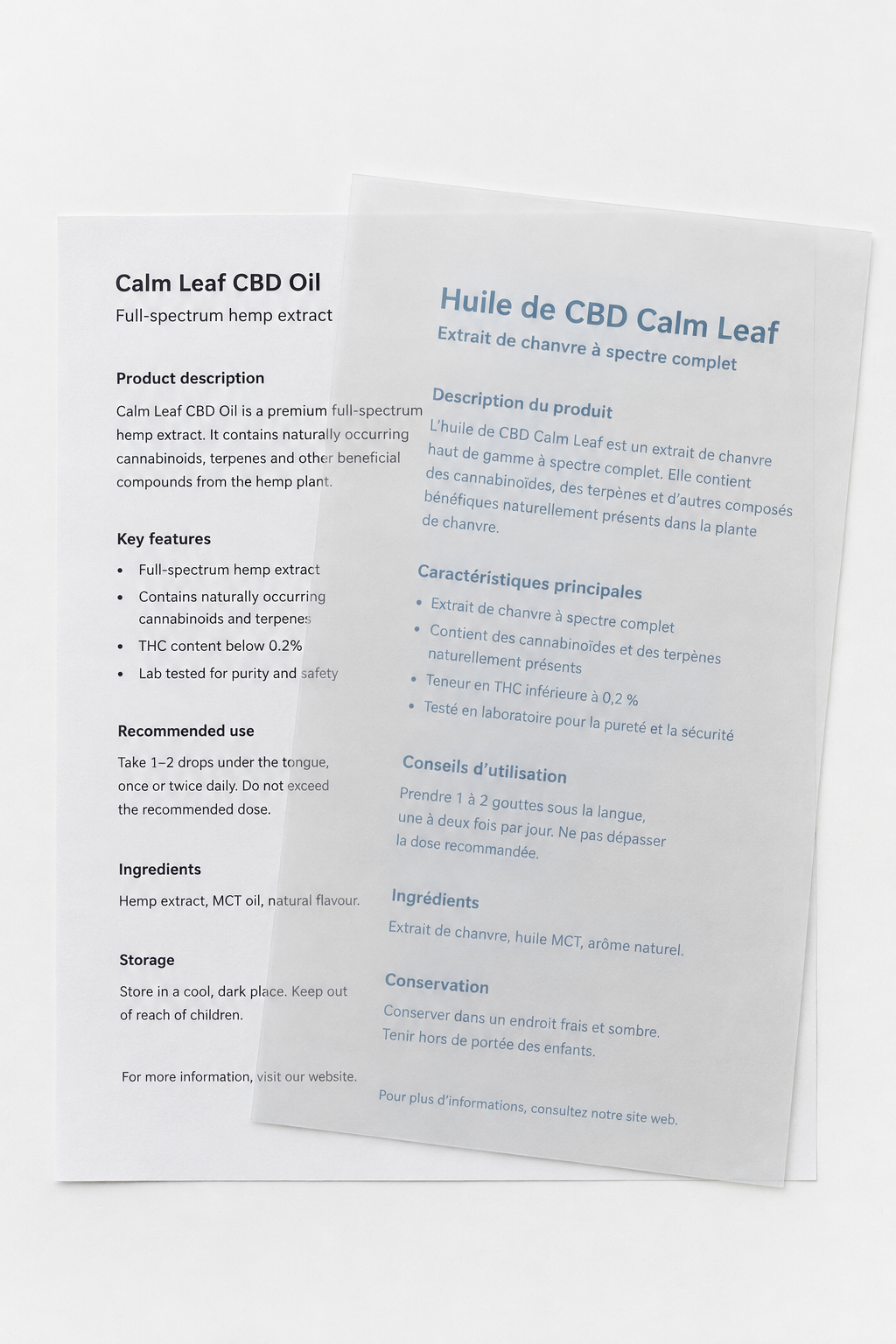
Take a product page with the claim “supports relaxation.” A translation tool can reproduce that wording accurately in German, French or Spanish. However, it will not establish whether the underlying claim is permitted for that product in any of those markets.
In Great Britain, the FSA has not authorised any health claims for CBD. Across the EU, Regulation (EC) No 1924/2006 requires health claims on foods to comply with the applicable authorisation requirements. Consequently, a claim that communicates a health effect may raise a regulatory issue regardless of translation accuracy.
The issue is not whether “supports relaxation” sounds right in German. It is whether the underlying claim is permitted for that product in that market. A generic translation workflow reproduces the wording. It does not make that assessment.
The novel food authorisation layer
In England and Wales, the FSA maintains a public list of CBD food products linked to novel food applications. Being on that list does not mean the product has received a novel food authorisation. The list identifies products linked to applications that have reached specified stages of the FSA’s process, including validated applications and applications awaiting evidence. As of publication, regulators have not authorised any CBD food product as a novel food in England and Wales. The FSA is due to present its first recommendation to ministers on 16 September 2026 — a step that, if approved, would mark the first formal CBD food authorisations in Great Britain. Translated marketing materials that use the word “authorised” could therefore misrepresent the actual regulatory status of the product.
2. A regulatory term that loses its legal meaning in translation
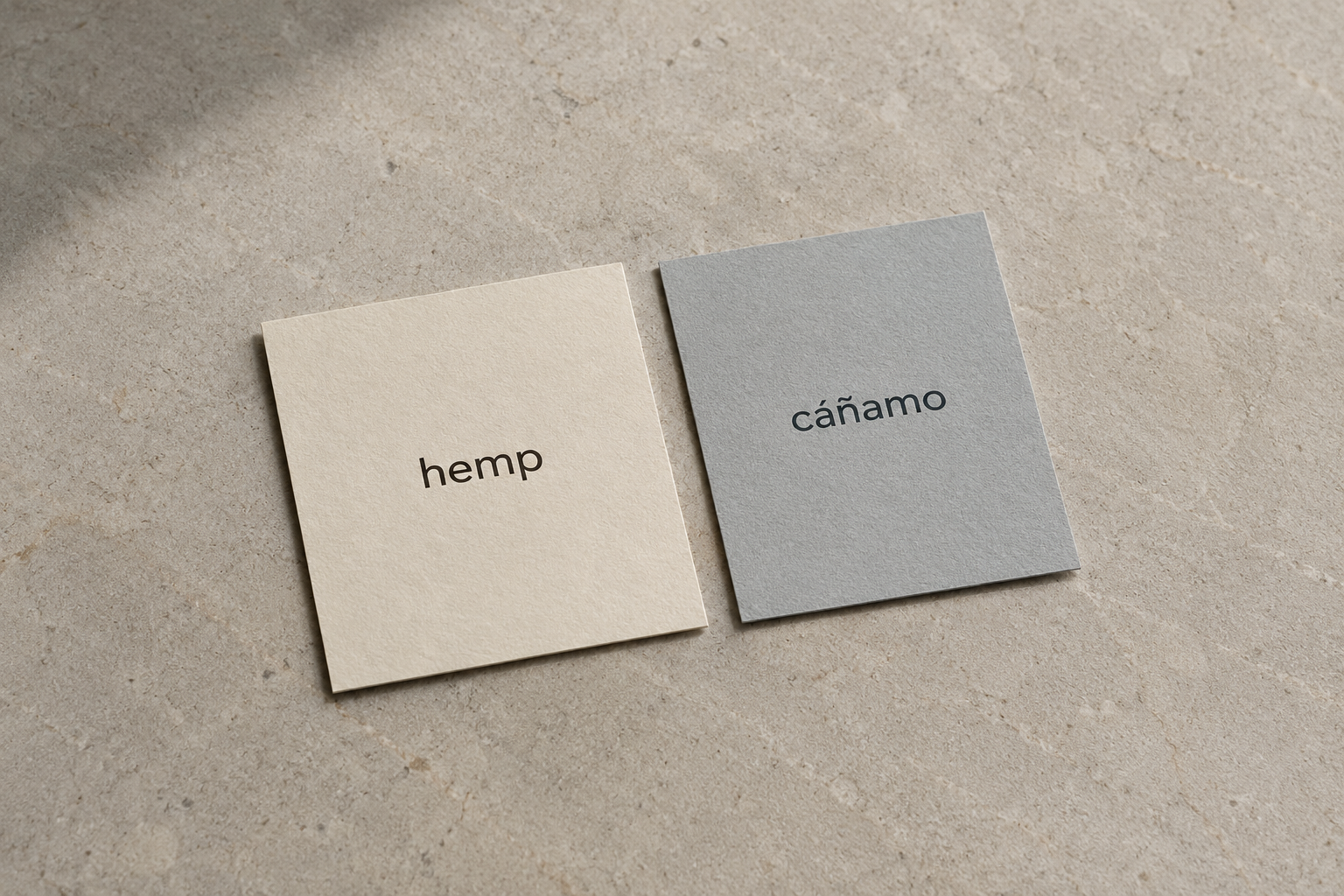
The German Anbauvereinigung — the membership-based cultivation association the Konsumcannabisgesetz (KCanG) introduced in 2024 — translates into English as “cultivation association.” That is accurate at the level of dictionary meaning. It does not, by itself, tell a Spanish operator what legal category the term refers to, what legal requirements an Anbauvereinigung must meet under German law, or how it differs from a commercial operator.
For a company evaluating whether to enter the German market, that distinction matters. A translation that renders the term without its regulatory context leaves the legally relevant meaning unexplained. The gap is not in the language — it is in what the reader needs to understand to make a sound decision. We covered how this plays out across 27 European frameworks in Cannabis Localisation in Europe: 27 Regulatory Vocabularies.
3. A dosage figure that means something different depending on which regulatory framework you are looking at
In February 2026, EFSA established a provisional safe intake level for CBD as a novel food in food supplements: 0.0275 mg per kilogram of body weight per day — approximately 2 mg per day for a 70 kg adult. That figure applies specifically to CBD isolate with a purity of at least 98%, produced under certain conditions, with genotoxicity excluded. EFSA has stated it will continue to assess individual novel food applications case by case.
The FSA and its advisory committee (ACNFP) have used a different provisional reference level: 10 mg per day for certain CBD products with a purity of at least 98%.
Two regulatory frameworks. Different provisional reference levels. A fivefold difference in the figure each framework uses in safety assessments.
An AI cannabis translation tool will render a product’s dosage labelling accurately from one language to another. It will not flag that the same number sits in a different position relative to the regulatory reference point in each framework. Moreover, it will not flag that the regulatory landscape is still moving. In 2026, the European Commission terminated multiple CBD novel food procedures without updating the Union list to authorise those products. For more on what those closures mean for operators, see CBD Novel Food Closures: What Operators Need to Know.
Safe ≠ authorised ≠ marketable
EFSA’s provisional safe level is not a novel food authorisation. EFSA has stated it will continue to assess individual applications case by case, and the CBD authorisation process in the EU remains open. Safe is not the same as authorised. Authorised is not the same as marketable. A translation tool will not make those distinctions for you.
The part of the process nobody has assigned to anyone
Here is what makes this harder to fix than it looks: the gap is rarely visible as a translation problem.
In most companies producing multilingual cannabis content, a marketing or communications professional manages the process. They are not a translator. They use AI tools to produce content at the speed and volume the business needs, and for general content, that works well enough.
The missing step is not translation quality. It is regulatory-aware localisation for cannabis content in Europe: checking whether the language accurately reflects the regulatory terminology, restrictions and market-specific context that apply where the content will be published. That step requires knowledge of the applicable framework — novel food status, health-claim restrictions, THC thresholds, advertising rules — combined with the linguistic expertise to apply it accurately.
That function often has no clear owner. Not because the company is being negligent, but because it does not look like a translation task. It looks like a compliance task. When both sit outside the company’s core competency, neither belongs to anyone.
The result can be content that passes internal review — it reads well, it sounds accurate — while a regulatory issue stays hidden until much later.
What this means for operators with content in multiple European markets
The regulatory frameworks that govern cannabis content in Europe are not static. EFSA’s February 2026 statement introduced a provisional safe intake level for certain CBD food supplements that does not, by itself, change the authorisation status of those products. In addition, the European Commission terminated multiple CBD novel food procedures in 2026 without updating the Union list. Furthermore, the KCanG created a distinct legal framework for cannabis cultivation associations in Germany that requires its own localisation treatment. Each of these developments creates a gap between what a translation tool produces and what is appropriate to publish in the target market.
For operators working with cannabis translation specialist services, the value is not simply fluency. It is making sure that multilingual content reflects the regulatory terminology, context and communication requirements of each market — and that the language layer does not distort or obscure the regulatory meaning that must be there.
A practical check for your current content: take one product page or customer-facing document that exists in more than one language. Ask whether anyone involved in producing the non-English versions was able to verify that the language accurately reflects the regulatory context of each target market. If the answer is no — or “we assumed the translation covered it” — that is the gap this post describes.
Sources:
EFSA — Provisional safe level for cannabidiol as a novel food (February 2026)
ACNFP/FSA — Safety Assessment on Cannabidiol (CBD) as a Novel Food for use in food supplements (RP350, updated 2024)
FSA — Register of CBD products linked to novel food applications
FSA — CBD products register guidance
FSA — CBD novel food applications: recommendations to ministers on first authorisations (September 2026)
ASA — Food: CBD & health, nutrition and disease treatment claims (2024)
European Commission — Union list of novel foods
European Commission — Decisions terminating novel food procedures
Regulation (EC) No 1924/2006 on nutrition and health claims made on foods
KCanG — Gesetz zum Umgang mit Konsumcannabis (2024)
AESAN — Preguntas y respuestas sobre el uso del cáñamo y cannabinoides en alimentación humana (marzo 2026)
Comentarios recientes