
In late July, Italy’s Guardia di Finanza raided a hemp operation in Lucca. The operation involved an agricultural company that had previously held authorisation to cultivate so-called canapa light. The Guardia di Finanza’s Nucleo Mobile confirmed that those authorisation titles had lapsed years earlier. The inspection uncovered a marijuana cultivation operation inside a greenhouse on the premises, leading to two arrests. The case raises a direct question for any supplier whose compliance dossier is meant to establish authorisation status: what can the documentation actually prove?
The case surfaced while Italy’s Corte Costituzionale still has pending constitutional challenges to Article 18 of the Decreto Sicurezza. Furthermore, that provision introduced restrictions on hemp inflorescences and products containing or derived from them. Notably, those constitutional challenges remain unresolved.
For hemp brands exporting from Italy to Germany or the UK, however, the detail that matters isn’t the raid. It’s what a buyer’s compliance team can verify from the documentation a supplier provides. A cannabis compliance dossier that states “EU hemp compliant” doesn’t answer that question.
Compliance Dossier: Why “EU Hemp Compliant” Isn’t Enough
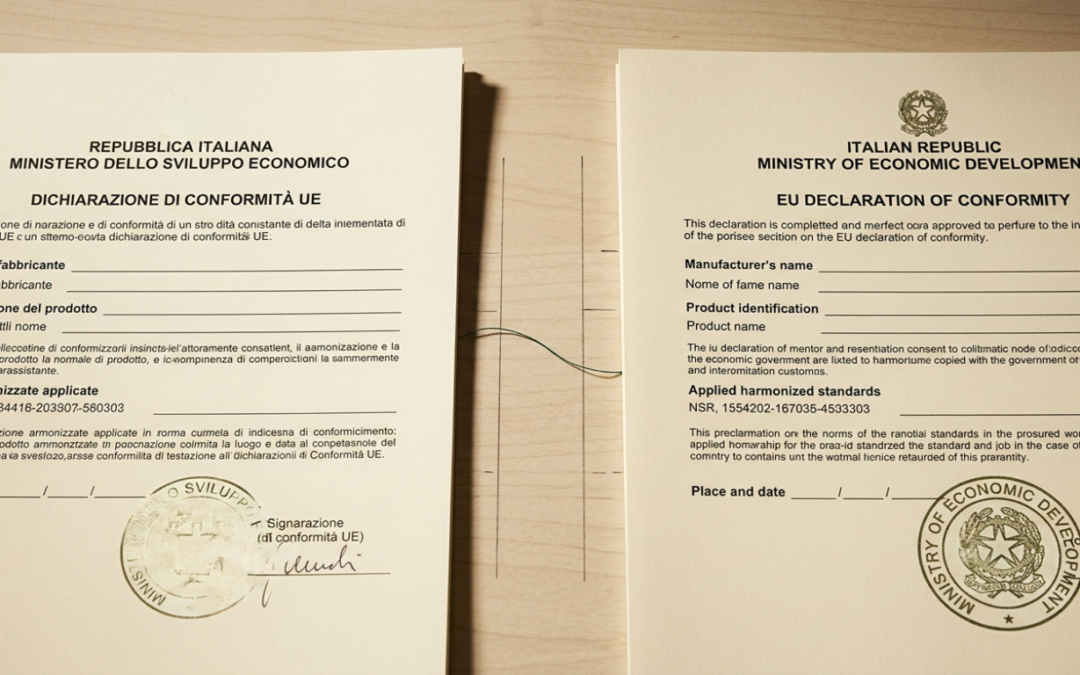
In practice, “EU hemp compliant” is often shorthand for claims about THC content and legal category — but it says nothing by itself about the regulatory documentation supporting a specific supplier, product or cultivation operation.
In the Lucca case, the company had previously held authorisation titles, but those titles had lapsed years earlier. That said, it does not establish a general rule that Italian industrial hemp cultivation requires a renewable cultivation authorisation. Italy’s Law 242/2016 permits the cultivation of listed hemp varieties without a specific authorisation. What the Lucca case illustrates is a different point. The regulatory documentation supporting a supplier’s position can become outdated, incomplete, or inapplicable — and a translated dossier will not flag that automatically.
The relevant distinction for a buyer is therefore not simply whether a product is labelled compliant. It is whether the supplier’s documentation clearly establishes the regulatory basis for the activity and product being offered, and whether those documents are current and applicable to that specific situation.
Where a specific Italian regulatory regime does require an authorisation or other administrative documentation, its status, issuing authority and validity should be clear in the supplier’s file. None of that, however, travels automatically into a translated compliance dossier. Someone has to deliberately put it there. Otherwise, a dossier built by copying and translating the source paperwork word for word will faithfully render whatever the original document says — including silence on current status, if the original is silent too.
Article 18 of the Decreto Sicurezza is still under constitutional review at the Corte Costituzionale. A public hearing is scheduled for 21 October 2026. Until those challenges are resolved, the legal framework governing hemp inflorescences remains subject to legal uncertainty. That is precisely why a dossier that distinguishes between a general product-compliance statement and the current status of the applicable regulatory documentation is worth more to a buyer than one statement that folds everything together.

Cannabis Documentation Across Borders: A Translation Problem, Not Only a Legal One
Translating a compliance dossier and building one a foreign buyer can act on are not the same task.
Typically, a generalist translator treats the source document as fixed. Whatever the Italian original states about the supplier’s regulatory position gets rendered into German or English. Any omission in the source stays an omission in the translation. That approach is defensible as translation. It is not, however, sufficient as compliance documentation.
A reviewer familiar with the applicable regulatory framework can identify when a document is missing information needed to establish its current status. They may also notice when the issuing authority named in a document does not match current practice. Alternatively, the document may refer to a pending administrative process that has not yet resulted in a current authorisation. A pending renewal application, for instance, may need to be distinguished from a currently valid authorisation, depending on the applicable regime.
These are details that can change what a buyer needs to ask for before proceeding. In short, none of this requires legal advice from a translator. It requires knowing what the relevant regulatory documentation is intended to establish. That means flagging when the translated file does not make that clear. This is exactly the gap between translating a document and localising it for its target regulatory context.
Specifically, this is the layer that sits between accurate translation and a document that does its job for a buyer’s due diligence team. Generalist agencies can handle the first reliably. The second requires familiarity with the regulatory context in which the document will actually be used.
Compliance Verification for B2B Buyers Entering the German or UK Market
A German or UK compliance team reviewing an Italian hemp supplier’s dossier may ask for several things. These typically include evidence relevant to THC content, the status of any applicable regulatory documentation, and traceability from production to shipment. Moreover, requirements vary significantly by market and product type — what a German buyer needs from a dossier and what a UK buyer needs are not necessarily the same.
The UK illustrates the point particularly clearly. Its industrial hemp licensing regime is limited to the non-controlled parts of the plant — seed and fibre. The licence does not allow for the use of flowers or leaves. An EU-facing compliance statement therefore cannot simply stand as a UK regulatory conclusion.
If the translated dossier states only that the product “complies with EU hemp regulation,” the buyer has two options. They can request the missing detail directly — which costs time — or proceed without full visibility into the supplier’s regulatory position. Notably, the challenge is not unique to Italy: Germany and Spain already demonstrate how little transfers between regulatory frameworks even for the same product.
Suppliers who establish their regulatory and documentary position clearly remove friction before the buyer has to ask. Consequently, that is a documentation and translation choice, not a legal one. It does not require predicting how the Corte Costituzionale will rule on Article 18. Instead, it requires making the supplier’s relevant regulatory and documentary position clear in the buyer’s language.
Hemp brands negotiating export contracts into Germany or the UK can reduce unnecessary back-and-forth. In practice, proactive documentation anticipates the due diligence questions a buyer will ask — before those questions delay the deal.
Conclusion
The Lucca case is a reminder that “compliant” and “currently authorised” are not interchangeable claims. It is also a reminder not to assume that every Italian hemp cultivation operation is governed by the same authorisation regime. For exporters, the more useful question is what the documentation actually proves.
Whatever the outcome of the constitutional challenges to Article 18, suppliers can already improve their regulatory documentation. Specifically, they can make clearer what it establishes — and what it does not. For brands building export documentation for the German or UK market, the question worth asking is simple. Does your compliance dossier distinguish between a general compliance statement and the specific regulatory evidence a buyer needs? Or does it rely on the buyer to assume they mean the same thing?
This article is for informational purposes only and does not constitute legal advice. Cannabis regulations change rapidly — verify current requirements with qualified legal counsel before making compliance decisions.
Sources:
1. Gonews.it / La Nación — Guardia di Finanza, Lucca, 28 luglio 2026
2. Il Post — ilpost.it
3. Corte Costituzionale, Ordinanza n. 26/2026 — cortecostituzionale.it
4. Legge 2 dicembre 2016, n. 242 — Normattiva
5. Home Office (GOV.UK) — Industrial hemp licensing — gov.uk
Comentarios recientes