
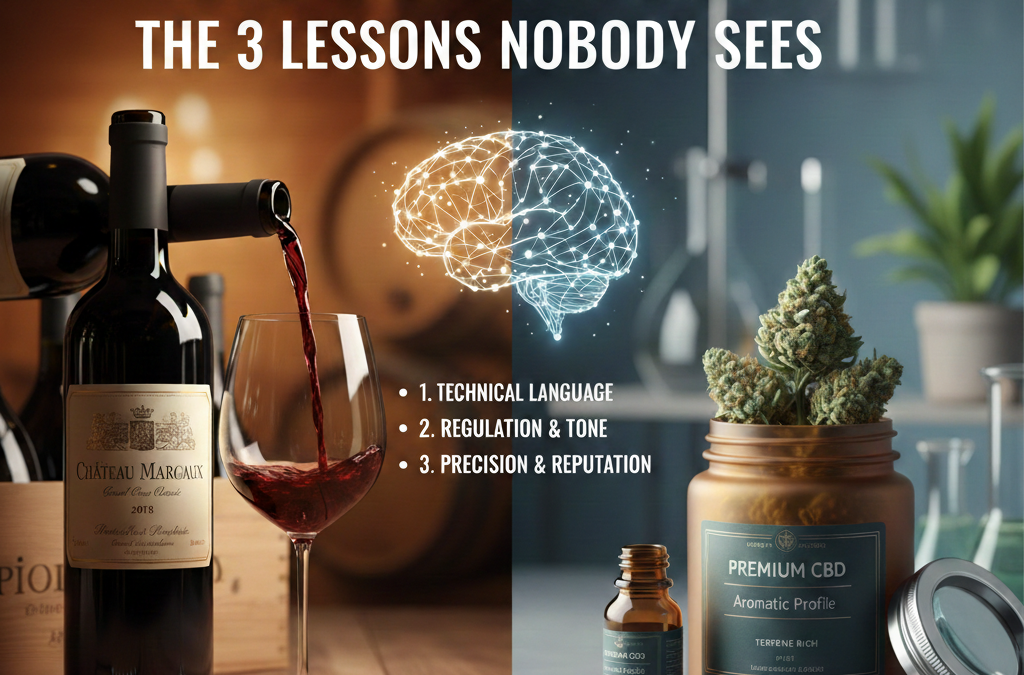
This parallel is exactly why quality cannabis translation services require the same depth of specialisation.
Reading time: 5 minutes
There’s something similar between opening a bottle of Château Margaux and examining a premium CBD jar. Both, for example, require precise vocabulary. Both, similarly, exist in markets fragmented by regulations. And both are surrounded by marketing filled with poorly translated terms. Professional cannabis translation services need to navigate both worlds simultaneously.
I spent a decade translating for luxury wineries and champagne houses. When I jumped into cannabis three years ago, the industry looked at me skeptically. So what does wine have to do with cannabis?
As it turns out, everything.
Lesson 1: Technical Language Can’t Be Improvised
In wine, there’s a chasm between “smooth and fruity” and speaking precisely about tannic structure, malic acidity, and bottle evolution. Ultimately, the difference determines whether you sell cases or build reputation.
In cannabis, the situation is identical.
When a brand sends me their catalog to translate, they’re not looking for linguistic equivalents. They’re looking for someone who understands cannabis translation services — including that “terpene profile” doesn’t always translate as “perfil de terpenos” in Spanish. Specifically, depending on context, it might be “composición terpenoide” (scientific), “perfil aromático” (commercial), or “familia de terpenos” (educational).
The difference isn’t aesthetic. In Spain, where medical cannabis is regulated but recreational isn’t, overly technical terminology can sound like an unauthorized medical claim. By contrast, in Canada, that same language builds credibility. A generalist translator doesn’t know this. A cannabis specialist, however, does.
Lesson 2: Regulation Dictates Tone
Working with French wines taught me you can’t call just any sparkling wine “Champagne”. Violating Protected Designations of Origin isn’t just illegal; it destroys reputation.
In cannabis, this goes even further.
I’ve seen US companies literally translate marketing campaigns with phrases like “CBD cures anxiety”. In the US, where the FDA regulates with nuance, this might fly. In Spain, where AEMPS is stricter, those phrases are illegal. Not “inadvisable”. Illegal.
Cannabis localization isn’t about changing words between languages. It’s about understanding that each market has a different level of regulatory maturity. Germany 2024 ≠ Uruguay 2013 ≠ Spain 2026. What works in one market scares or confuses another.
Lesson 3: Precision Protects Reputation and Money
In luxury wine, a translation error on a tasting sheet can cost tens of thousands of euros. Confusing “new barrel” with “new oak” makes an importer reject entire orders.
Cannabis amplifies this with legal risk.
A company contacted me after automatically translating their website. The result included “our THC extracts are ideal for children with epilepsy”. The original intention was to discuss CBD (not THC) in clinical studies with minors. The automatic translation missed the nuance. If they’d launched that site without review, they’d face serious regulatory sanctions.
Specialized translation isn’t a luxury. It’s risk mitigation.
Cannabis Translation Services: The Real Cost of Going Generic
I’ve seen companies spend €15,000 auto-translating their catalog, only to redo everything six months later because product descriptions confused customers, legal texts didn’t comply with local regulations, and the overall tone made the brand sound amateur.
Cost of redoing + lost opportunity: over €40,000.
If they’d invested €8,000 in specialized translation from the start, they’d have saved €32,000 and six months of competitive advantage.
Ready to protect your brand from day one? Request a free quote and see how specialized cannabis translation services save you time, money, and regulatory risk.
The Question That Matters
If you’re expanding your cannabis brand to new markets, the question isn’t “do I need translation?”. For a comparison of how different European markets approach this, see the EMCDDA EU Drug Markets report.
The question is: “does my provider truly understand my sector?”.
Does your translator know the regulatory differences between Spain, Mexico, and Argentina? Do they understand that “medical cannabis” has different connotations in each market? Can they advise you on which claims are legal in Germany but not in France? Do they know the evolution of cannabinoid terminology over the past two years?
If not, you don’t have a translation provider. You have an operational risk.
About Cannaspeaks
We’re one of the very few language consultancies specialized exclusively in cannabis. We combine over 10 years of experience in regulated sectors with deep knowledge of the cannabis industry, its changing regulations, and its cultural particularities by market.
If your company is expanding to Spanish-speaking or English-speaking markets — see who we’ve worked with —, and you need your communication to be precise, compliant, and effective, let’s talk.
Content intended for cannabis industry professionals and adults in jurisdictions where cannabis is legal. Consult your local regulations before acting on any information in this post.
Recent Comments