
⚠️ Update — May 2026
This article was published in March 2026. On 8 May 2026, the Spanish Supreme Court issued ruling STS 1993/2026, which materially changes the legal landscape for CBD flower products in Spain. The ruling establishes that hemp flowers can be classified as narcotics under Article 368 of the Criminal Code regardless of THC percentage, applying instead a threshold of 10 mg of total THC (the minimum psychoactive dose recognised by the INT). This contradicts the previous psicoactivity-based standard (STS 726/2015) and creates significant legal uncertainty for brands selling or distributing CBD flower products in Spain. The sections on flowers and THC thresholds below reflect the framework as of March 2026 and should be read in light of this development. Legal challenges to the ruling are ongoing. If you need current guidance on how this affects your operations or communications in Spain, contact us directly.
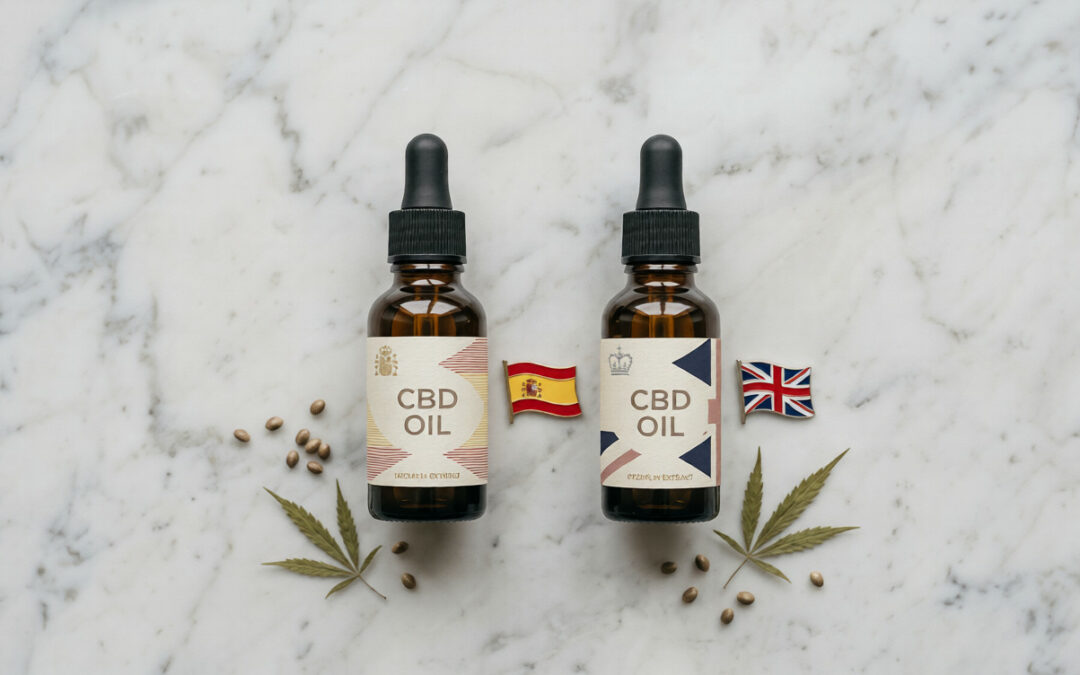
A British CBD brand decides to expand into Spain. They have their ingestible product ready, their packaging sorted, their website translated. They launch.
Within weeks, the product gets pulled.
What happened? In Spain, ingestible CBD products aren’t authorised. That’s it. It didn’t matter that they’d been on the UK market for two years with a live FSA application. The frameworks are different, the rules are different, and what you’re allowed to write on a label is different too.
This isn’t a rare story. Companies moving between Spain and the UK routinely assume the regulatory logic of one market transfers cleanly to the other. It doesn’t.
The two countries shared a common foundation until Brexit. Since then they’ve been pulling apart in ways that have real operational consequences. This affects product formulation, labelling, and especially the texts that describe what a product is and does.
What follows covers the three compliance gaps that cause the most trouble for brands navigating both markets. It draws on specific data about what’s changed and what it means for your product copy and marketing claims.
This article is for informational purposes only and does not constitute legal advice. Regulations in this sector change frequently — always consult a qualified legal professional before entering a new market.
Same plant, different rulebook: how Spain and the UK diverged on CBD
Until 2020, both countries operated under the same EU Novel Food Regulation, which in 2018 classified CBD extracts as novel foods requiring authorisation before sale for human consumption. Then Brexit happened, and the UK’s Food Standards Agency built its own parallel pathway.
Today you have two separate regulatory processes. These differ in safety thresholds, timelines, and the data an application needs to include. Both are slow.
As of early 2026, no ingestible CBD product has received full authorisation in either market. The UK is further along. Three CBD isolate applications have received positive safety assessments from the FSA — a meaningful step, though not the same as market authorisation. In the EU, including Spain, EFSA has not authorised any ingestible CBD product, and its September 2025 update raised the bar for applications significantly.
So when a brand says “we’re compliant in one market, we just need to localise for the other” — that’s the assumption that gets them into trouble.
Three compliance gaps that trip up brands expanding between Spain and the UK
1. What you can actually sell
This is where the difference is starkest, and where brands get the most expensive surprises.
In Spain, ingestible CBD products — oils marketed as dietary supplements, gummies sold for consumption — sit in a legal grey zone that is, in practice, a prohibition. The AEMPS has not registered CBD as a food supplement.
You can legally sell products for external use and cosmetics under EU cosmetic safety regulations. The 0.2% THC figure the industry commonly cites applies to hemp cultivation, not to finished cosmetic products — but it functions as a practical reference point for formulators. Flowers exist as aromatic or collectible products.
An ingestible oil marketed as a supplement? Routinely confiscated. For any brand looking to sell CBD legally in Spain, the only clear-cut path right now is cosmetics and topicals.
In the UK it’s different, though not simple. Ingestible products can remain on the market if they’re linked to a credible, active application on the FSA’s public list. Regulators treat products without that link as unauthorised and require their removal from sale. The FSA has been clear about this.
A product your UK team has been selling legally for two years could be a seized item on day one in Spain. Category comes before language.
2. THC limits — not what most people think
There’s a misconception here that causes genuine problems, and it’s worth being direct about it.
The 0.2% THC figure that circulates everywhere refers to the THC limit for hemp cultivation in the EU. It is a cultivation standard. It is not a finished product safety threshold, and treating it as one leads brands into formulation and labelling decisions they’ll later have to undo.
For finished CBD products in the UK, the FSA established in 2025 a safe upper daily intake of 0.07mg of THC — corresponding to a provisional acceptable daily intake of 10mg of CBD per day for healthy adults.
That 10mg figure replaced the earlier 70mg guidance in 2023, after the FSA reviewed safety data submitted by industry during the novel food process. It’s advisory rather than a hard legal cap, but applications that have cleared positive safety assessments adhere to it, and the FSA is encouraging existing brands to reformulate.
In Spain, there’s no officially published finished-product THC threshold for ingestibles — because those products aren’t officially recognised in the first place. For cosmetics, EU cosmetic safety regulations apply their own criteria, separate from the cultivation standard.
CBD labelling requirements in the UK now need to reflect both the 10mg ADI and safety warnings for vulnerable groups — something many brands formatted before the 2023 revision haven’t adjusted yet.
3. What you can say — where most brands underestimate the risk
This is the gap that gets the least attention and causes the most visible problems. You can have the right product, the right formulation, the right THC levels — and still end up with a compliance issue because of your copy.
In both markets, regulators prohibit medical claims without regulatory approval. But the specific language risks differ, and some of them are surprisingly granular.
In the UK, the word “dose” on a food product can trigger reclassification as a medicine under MHRA criteria. Not the intent — the word itself, because it implies therapeutic administration. Similarly, phrases like “clinically proven,” “treats,” or “relieves” push a product toward medicine territory. The ASA actively investigates CBD advertising for exactly these signals, and the consequences of getting it wrong aren’t just a slap on the wrist.
In Spain, the AEMPS prohibits marketing CBD as a treatment or promoting it for any therapeutic use, regardless of how a brand interprets the available scientific literature. Claims like “reduces anxiety” or “improves sleep quality” aren’t permitted in Spanish product texts or marketing materials — and to be clear, they’re equally problematic under UK advertising standards.
A text written for the UK market, translated word for word into Spanish, doesn’t just have linguistic issues. It may make claims that a completely different regulatory framework prohibits.
That’s not a translation problem. It’s a localisation problem — and the two are not the same thing.
What actually happens when brands get this wrong
The costs range from operational disruption to something harder to quantify.
In Spain, enforcement against grey-market CBD operators has been consistent in recent years — products confiscated and stores raided even in markets where tolerance was historically higher. In the UK, the FSA’s 2025 guidance update on THC limits and the revised CBD daily intake has prompted a round of reformulations. Packaging that was compliant twelve months ago may need to change now.
But the less obvious cost is reputational. A product recall leaves a digital trace. Distributors remember. Retailers who got caught stocking something non-compliant don’t forget.
For a brand in the early stages of building presence in a new market, a compliance failure in year one can quietly close doors that take a long time to reopen.
Most of this is preventable. The root cause is almost always the same: assuming that what works in the home market works elsewhere, and translating materials without auditing the claims first.
A practical starting point — before you translate anything
Three things worth having in place before any product text leaves your desk for a new market.
Know the product’s regulatory category in the destination market first. Is it a cosmetic? A food supplement? An aromatic product? The category determines which agency regulates it, what claims regulators permit, and what labelling they require. This step comes before translation, not after.
Audit your existing texts for language that doesn’t travel. Identify the terms that create regulatory risk in the destination market — words that imply medicinal use, dosage language, efficacy claims. This doesn’t require a lawyer. It requires knowing which words activate which categories, and doing that work before you translate rather than after you launch.
Build separate review processes for each market. Spain and the UK have different regulatory bodies, different enforcement patterns, and different standards for what belongs on a label. A single compliance workflow that just changes the language doesn’t account for that. Each market needs its own validation step.
The compliance gap is also a language gap
The more you work through these differences, the clearer it becomes that compliance in this sector isn’t just a legal problem. It’s a language problem.
The same product, described in the same way, can be compliant in one jurisdiction and not in another. The regulatory frameworks don’t just differ in what products are allowed — they differ in what language is allowed to describe them.
That’s not something a generic translation resolves. It requires understanding both the regulatory context and the specific linguistic register of each market. This means knowing what a word implies, what category it invokes, and what a regulator reads when they see it on a label.
For more on how lessons from established industries apply to cannabis market entry, see From Wine to Cannabis: The 3 Lessons Nobody Sees.
The regulatory landscape in Spain has shifted significantly since this article was published. If you are assessing how recent legal developments affect your product communications or market entry materials, we are glad to help.
Sources
- Food Standards Agency — Cannabidiol (CBD) guidance for businesses (updated 30 June 2025): https://www.food.gov.uk/business-guidance/cannabidiol-cbd
- Food Standards Agency — FSA and FSS update consumer advice for CBD (October 2023): https://www.food.gov.uk/news-alerts/news/food-standards-agency-and-food-standards-scotland-update-consumer-advice-for-cbd
- Food Standards Agency — CBD Novel Food Applications (Board paper, 2025): https://www.food.gov.uk/board-papers/cbd-novel-food-applications
- Food Standards Agency / Food Safety Magazine — FSA sets safe upper limit for THC in CBD novel foods (July 2025): https://www.food-safety.com/articles/10494-uk-sets-safe-upper-limit-for-thc-in-cbd-novel-foods
- EFSA — Novel Food Catalogue, CBD entry (2025): https://www.efsa.europa.eu/en/applications/novel-foods/catalogue
- AEMPS — Cannabis, medicamentos y productos sanitarios: https://www.aemps.gob.es/medicamentos-de-uso-humano/cannabis/
- Prohibition Partners — CBD in Europe 2025 (October 2025): https://prohibitionpartners.com/2025/10/18/cbd-market-overview-europe-2025/
- Mariscal Abogados — The sale of CBD in Spain: https://www.mariscal-abogados.es/es/venta-cbd-espana/
This article is for informational purposes only and does not constitute legal advice. Cannabis regulations change rapidly — verify current requirements with qualified legal counsel before entering any market.
Getting the terminology right on both sides of the Channel requires jurisdiction-specific expertise. See Cannaspeaks’ cannabis translation specialist services for UK and Spanish markets.
Recent Comments